Leadership Steel
“Leadership Capability Is Structural... Not Developmental.”
Andy Begley
2/25/20264 min read

Leadership Steel
Andy Begley 25/02/26
Why Leadership Capability Is Structural, Not Developmental
Following a recent engagement with a client, I’ve been wrestling with this frustrating question:
Why do we still treat leadership development as a programme, when leadership capability is structural?
During the engagement we were working through how to design a compelling offer that would genuinely help employers build leadership capability that drives business development and performance. The conversation began conventionally enough: curriculum, delivery models, commercial positioning. But it did not stay there. Very quickly, the discussion shifted from courses to consequences. From content to control. From learning to load-bearing… and that is where the metaphor emerged.
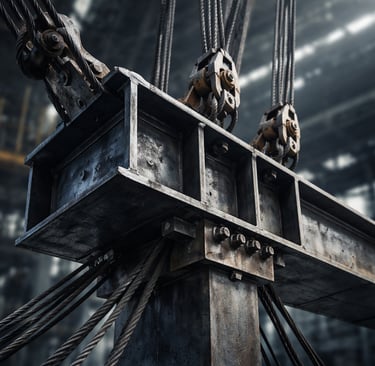
Leadership capability is the steel frame within the 'building'.
It is not the paintwork, it is not the interior design, it is not an optional extension, it is the structure that holds the entire enterprise upright.
The Mis-classification Problem
In most organisations, leadership development sits within Organisational Development or Learning and Development. It is managed as a programme, it competes annually for budget, and it’s measured in participation rates. Yet consider what established theory tells us:
The Resource Based View of the firm argues that sustainable competitive advantage arises from capabilities that are valuable, rare, difficult to imitate, and embedded within the organisation ¹. Leadership capability, when genuinely developed and culturally embedded, meets those criteria. Dynamic Capabilities theory extends this argument. It proposes that an organisation’s long-term performance depends on its ability to sense changes, seize opportunities, and transform accordingly ². Those are leadership functions. Upper Echelons theory demonstrates that organisational outcomes are influenced by the characteristics and cognition of senior leaders ³. Decision quality at the top cascades through the system. And research on psychological safety, most prominently associated with Amy Edmondson ⁴, shows that leadership behaviour shapes learning, innovation, and error detection. These are not soft outcomes. These are operational imperatives.
Taken together, these frameworks point to a simple conclusion; leadership capability is not peripheral, it must be central. And yet structurally, we often treat it as ancillary.
The Context Has Changed
This mis-classification might once have been survivable, but it’s becoming dangerous:
The World Economic Forum’s Future of Jobs Report repeatedly identifies skills gaps as one of the most significant barriers to organisational transformation ⁵. The Microsoft Work Trend Index documents how organisations are restructuring work around artificial intelligence and human collaboration ⁶. Leaders are now expected to manage not only people but the interaction between people and AI systems. When the speed of decision-making increases, poor judgement scales faster. When information becomes abundant, discernment becomes scarce. In this environment, weak leadership does not fail quietly. It amplifies risk. It slows transformation. It becomes the operational constraint.
The Structural Analogy
In structural engineering, the steel frame performs four essential functions:
• Load bearing: It carries the weight of the structure.
• Alignment: It ensures forces are distributed coherently rather than creating torsion.
• Shock absorption: It allows adaptation under stress.
• Integrity: It prevents catastrophic collapse.
Leadership capability performs the same functions within organisations.
• It carries strategic weight.
• It aligns cross-functional effort.
• It absorbs volatility.
• It protects ethical and reputational integrity.
If the steel frame weakens, the ‘building’ will deform before it collapses. It is not always immediately visible, but without remedial action, the consequences may be permanent and catastrophic.
Performance declines, culture fractures, talent exits and risk compounds. The warning signs are subtle at first, but they are structural.
The Governance Contradiction
Boards scrutinise financial controls and cyber resilience in detail. They recognise these as essential infrastructure elements. Leadership capability (quality), which influences both, is rarely governed with the same structural seriousness. Instead, it is reported as programme completion or simple statistics to demonstrate engagement.
We don’t measure financial surety or cyber security by training attendance, so why are we measuring leadership capability that way?
If leadership determines execution, then it should be stress-tested against strategy.
If leadership shapes culture, then it should be visible in succession readiness.
If leadership effects retention, then it should be part of competitive advantage conversations.
Deloitte’s global research on Gen Z and Millennial workforce attitudes ⁷ consistently indicates that development, meaningful work, and effective leadership influence employment decisions. Leadership quality now directly effects attraction and retention. Pay may attract attention, but trust and progression sustain commitment.
From Development to Assurance
The insight from the recent engagement wasn’t that leadership development needs better content. It was that leadership capability needs repositioning. (now)
From programme to assurance; from initiative to infrastructure, what might that mean in practice?
• It means defining leadership standards against critical roles, not generic competencies.
• It means connecting leadership capability directly to strategic priorities and risk.
• It means assessing demonstrable behaviours in role, not just attendance at events.
• It means treating succession planning as a structural audit, not an annual ritual.
It means asking a simple but uncomfortable question:
If leadership capability were removed tomorrow, what risk would the organisation feel?
If the answer is significant, then leadership must be structural.
Structural integrity is engineered, stress tested, monitored, and constantly re-assessed.
These are not discretionary functions.
The Challenge
We may not need more and more leadership programmes; but we do need a different ‘structural’ mindset. One that recognises leadership capability as embedded organisational steel. If leadership is the constraint on transformation, productivity, AI adoption, and cultural resilience, then surely it cannot remain positioned as part of a discretionary HR programme. It must be seen, governed, and resourced as foundational infrastructure.
So here is the question I am testing: Is leadership development in the wrong place?
Should leadership capability be treated as structural infrastructure at board level, rather than primarily as an HR initiative?
I am genuinely interested in whether others see leadership through this structural lens. Because in volatile environments, buildings do not fail because of poor decoration. They fail because the frame cannot carry the load.
END
References:
1. Barney, J. (1991). “Firm Resources and Sustained Competitive Advantage.” Journal of Management, 17(1), 99–120.
2. Teece, D., Pisano, G., & Shuen, A. (1997). “Dynamic Capabilities and Strategic Management.” Strategic Management Journal, 18(7), 509–533.
3. Hambrick, D. & Mason, P. (1984). “Upper Echelons: The Organization as a Reflection of Its Top Managers.” Academy of Management Review, 9(2), 193–206.
4. Edmondson, A. (1999). “Psychological Safety and Learning Behavior in Work Teams.” Administrative Science Quarterly, 44(2), 350–383.
5. World Economic Forum (2025). The Future of Jobs Report 2025. Geneva: WEF.
6. Microsoft (2025). Work Trend Index Annual Report: The Year the Frontier Firm Is Born.
7. Deloitte (2025). Gen Z and Millennial Survey 2025.
07875433129
andy@andybegley.co.uk
© 2026 Andy Begley. All rights reserved.