Why I founded Vekta
An insight into why I founded Vekta, and how years of leadership, governance, and transformation experience revealed a common organisational problem
Andy Begley
5/12/20263 min read
Why I Founded Vekta
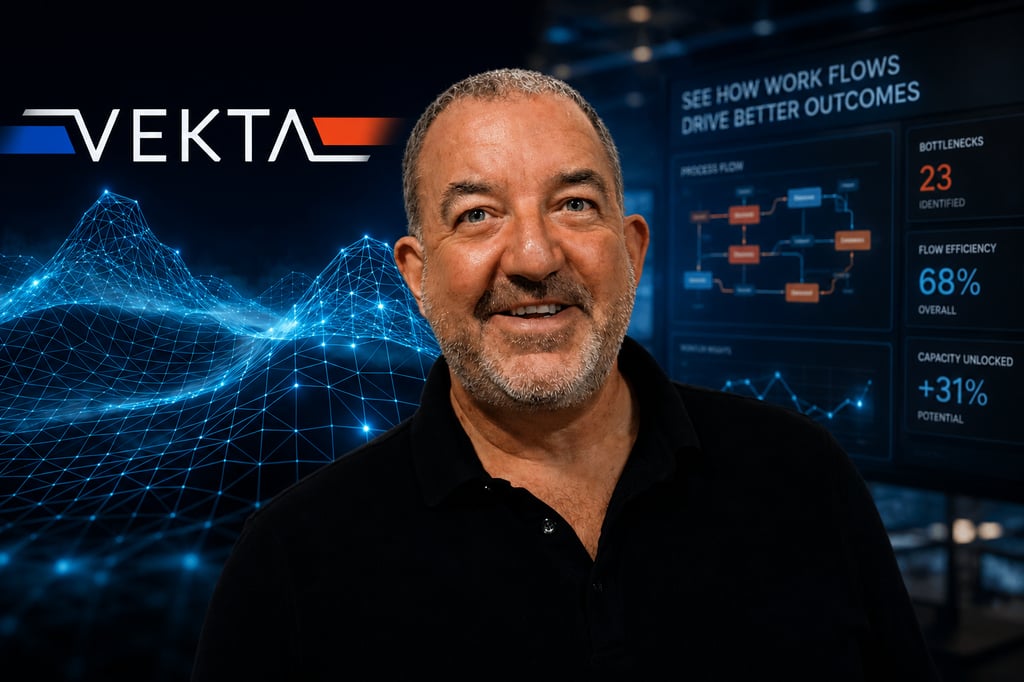
Alongside my advisory and board work, I’m also the Founder and Director of Vekta. Until recently, I’ve probably spoken less publicly about the connection between the two than I should have, partly because, to me, the connection has always felt obvious.
What I kept seeing
Over many years leading and advising complex organisations, across both public and private sectors, I kept encountering the same underlying problem.
Leaders were expected to improve performance, reduce cost, increase productivity, strengthen governance, manage risk, deliver transformation, and absorb continual change… without ever being able to clearly see how work actually flowed through their organisations.
Processes often looked sensible on paper; operational reality was usually much more complicated.
· Work duplicated itself across teams.
· Decision-making slowed through layers of process.
· Reporting multiplied.
· Governance became heavier.
· Technology was introduced into workflows that were already fragmented.
· Capacity quietly disappeared into organisational friction.
Most leaders recognised the symptoms. Fewer could properly see the system producing them… and that distinction matters.
One of the things I learned over many years in executive leadership is that organisations rarely behave exactly as they describe themselves. Structures, governance frameworks, reporting lines and process maps often present a version of organisational reality that feels coherent and rational. The lived experience inside systems is frequently very different.
What happens under pressure
This becomes particularly important in periods of pressure.
Under financial strain, operational complexity tends to compound itself. Additional controls are introduced. More reporting appears, approval routes lengthen, risk management expands, meetings increase and layers accumulate - all of it done with good intent.
But over time, organisations can find themselves carrying enormous operational weight that nobody deliberately designed.
That challenge exists across sectors. I have seen versions of it in public services, commercial organisations, regulated environments, transformation programmes, and advisory work.
And increasingly, I became interested in a simple question: What if leaders could properly see how work actually behaves inside their systems?
Not theoretically but genuinely, as it is, … operationally.
Why Vekta
That question became a large part of the thinking behind Vekta.
Vekta was not created as a technology exercise, or as another dashboard platform competing for executive attention. It emerged from a practical operational problem: organisations often struggle to improve because they cannot clearly visualise flow, friction, bottlenecks, duplication, delay, and decision behaviour across complex systems.
The purpose of Vekta is straightforward: to help organisations understand how work actually moves.
That includes identifying process friction, visualising operational flow, understanding bottlenecks, improving capacity, supporting better decision-making, and helping leaders connect operational reality with strategic intent.
Technology isn’t the answer on its own
Importantly, I do not believe technology alone improves organisations - in fact, many are currently discovering the opposite.
AI, automation, digital tooling and workflow platforms all create potential. But potential only becomes meaningful when leadership, governance, organisational design and operational clarity move together… otherwise complexity simply accelerates.
How it connects to my wider work
This is one of the reasons Vekta sits very naturally alongside my wider advisory and board work.
Both are concerned with the same underlying questions:
· How do organisations behave under pressure?
· What is helping performance?
· What is creating friction?
· What is distorting decision-making?
· What is the system currently designed to produce?
And perhaps most importantly:
How do leaders create organisations capable not just of activity, but of intentional improvement over time?
That thinking also sits behind my broader work on The Blueprint for Intentional Systems; the idea that organisational performance is rarely accidental, and that sustainable improvement depends on alignment between purpose, people, process, and performance.
In many ways, Vekta is simply a practical operational lens into those same leadership questions.
After more than twenty-five years working in leadership, governance, transformation and operational delivery, I have become increasingly convinced that most organisations do not fail because people lack commitment or capability.
More often, they struggle because complexity quietly overwhelms clarity. Organisations improve when leaders can finally see how their systems truly behave.
More information about Vekta can be found at: www.vekta.online
07875433129
andy@andybegley.co.uk
© 2026 Andy Begley. All rights reserved.